
Basic first aid is the immediate care given to a sick or injured person. In some cases, it may be the only care a person needs. In other cases, first aid is a way to prevent a person’s condition from worsening and keep them alive until paramedics arrive or they are taken to the hospital.
The best way to prepare for these events is to get official first-aid training. In the meantime, there are some basic life-saving steps you can learn.
:max_bytes(150000):strip_icc():format(webp)/GettyImages-1151757436-77f2d3878adf46dea17d31477e2bfac6.jpg)
Assess the Situation
The first thing to do in any medical emergency is to assess the situation. Questions to ask and steps to take include:1
- Is the scene safe? Assess what is going on around the injured individual. Consider whether they are safe where they are and whether you can safely approach them. Check if you have personal protective equipment (e.g., gloves) in case of blood or other bodily fluids. If they are conscious, you can ask for consent.
- Is the person responsive or unresponsive? The American Red Cross recommends the shout-tap-shout method to assess whether a person is conscious. Check if the person is responsive, if you see any life-threatening bleeding, if they are breathing, and if you notice any other significant injuries or conditions.
- Do you need emergency medical responders (EMS)? If the individual does not respond, responds but is unable to remain fully awake, is not breathing or is gasping, or has significant bleeding, call 911 and begin CPR if there is a potential for cardiac arrest. Obtain an automated external defibrillator (AED) if possible. Do the same if you have concerns about any life-threatening medical condition,
- Is the person okay without emergency medical help? The individual may be OK after a minute or brief care. If the person is conscious and talking, you can offer continued assistance. Consider asking if any underlying medical conditions may require further care. If a possible head, neck, or spinal injury occurred, ask the person to remain still until emergency medical personnel arrive.
- Continue to provide emergency medical care based on your level of training and comfort with the situation. Call 911 if needed and if not already done. If EMS is called, remain with the individual until help arrives.
ABCDEs of First Aid
If someone is unconscious or unresponsive, the basic principles of first aid are the ABCs: airway, breathing, and circulation.2
- Airway: If someone is not breathing, you first need to open their airway, if possible.
- Breathing: If you have cleared a person’s airway but they are still not breathing, consider providing rescue breathing if you feel comfortable doing so.
- Circulation: As you perform rescue breathing, continue with chest compressions to maintain the person’s blood circulation. If the person is not responsive, check their pulse. If you do not feel a pulse, begin chest compressions.
Some first aid courses also include D and E:3
- Disability: In the acronym, disability refers to conditions that affect the level of consciousness. Consider if the person has an altered mental state, is experiencing a seizure, may have overdosed, is experiencing hypoglycemia, or has another condition that affects their ability to remain fully conscious.
- Exposure: If the person has experienced exposure to something harming them, remove the exposure if possible. For example, provide warm, dry clothing if there is a risk of hypothermia and their clothes are wet. Make a note if they’ve been exposed to a snake bite or other poisonous animal. Another example is removing constrictive items if necessary (e.g., jewelry or watches).
Where to Get First Aid Training
Taking a formal CPR class will help you become familiar with doing chest compressions, rescue breathing, and using an AED. You can find courses from the American Red Cross, your local community first responders, and online.
1. Cardiac Arrest
:max_bytes(150000):strip_icc():format(webp)/GettyImages-505252032-56d1ec685f9b5879cc81553d.jpg)
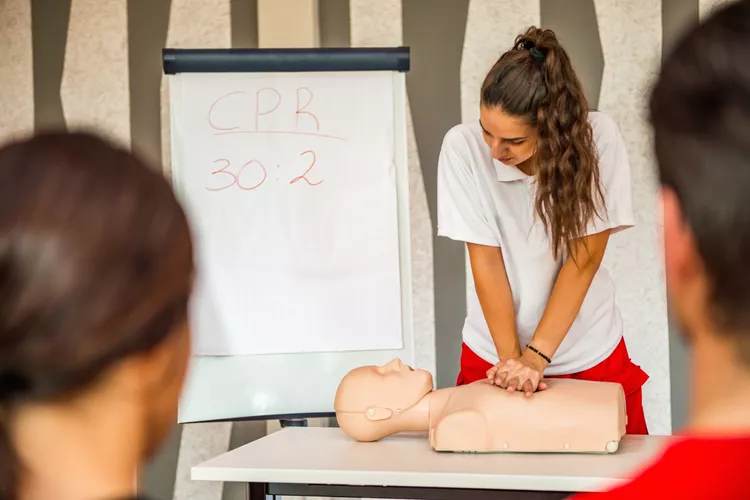
Cardiopulmonary resuscitation (CPR) is one of the most important emergency medical procedures that a person can know.
When a person is in cardiac arrest (the heart is not beating), doing CPR and/or using an AED could restart their heart and/or recirculate blood until their heart can be restarted with a defibrillator.4 This can restore their life.
AEDs are available in many public areas and businesses. These first-aid devices are designed to be easy to use, even without prior training.
If you think someone is in cardiac arrest, here’s what to do next:5
- Get help: Find a person nearby. Make eye contact, point to them, and say, “Call 911.”
- Chest compressions: If there is no pulse, start chest compressions. Use both your hands and push down hard and fast in the center of the person’s chest. Let their chest rise naturally between compressions. You may hear pops or snaps; this is normal. Keep going until help arrives.
- CPR: If you’re trained in CPR, you can use chest compressions and rescue breathing.
- AED: If it’s available, use an AED. However, do not put off doing chest compressions to go look for an AED. If possible, instruct someone else to go find the device and bring it to you.
2. Bleeding
:max_bytes(150000):strip_icc():format(webp)/GettyImages-525386797-5a6a1eccfa6bcc003690b97f.jpg)
If someone is injured and bleeding, there are a few basics about how blood works that will be helpful for you to know.
The color of the blood and how it’s leaving the body can look different depending on the injury:
- Capillaries: Bleeding from the smallest blood vessels (capillaries) looks like a trickle. This kind of bleeding usually stops on its own.
- Veins: Bleeding from veins can range from mild to severe. The blood can appear like a trickle, flow, or, in some situations, spurt.6
- Arteries: Arteries are the largest blood vessels and carry a lot of oxygen. If they are injured, bright red blood will spurt out. Blood can be lost very fast with this kind of bleeding.
In many cases, external bleeding can be controlled with first aid. In cases of severe bleeding, an individual may go into shock and potentially die.7
While it is essential to stop bleeding, begin with the ABCs of first aid.8
Here’s what to do next:
- Gloves: Put on disposable gloves if you have them. This will protect you from infectious diseases like viral hepatitis and HIV/AIDS that can be spread in a person’s blood.9
- Cleanse: Rinse the wound with water.
- Cover: Protect the wound with gauze or cloth (e.g., towel, blanket, or clothing).
- Stop the bleeding: Apply direct pressure to stop blood flow and encourage clotting.
- Elevate: Move the bleeding body part above the person’s heart if possible.
- Leave clothing on: Do not remove the clothes if they become soaked. Removing the first layer may interfere with the clotting process and can result in more blood loss. Instead, add more layers if needed.
- Protect: Once bleeding has stopped, put a clean bandage on the wound.
Get medical help if:10
- The wound is deep.
- The wound has widely separated sides.
- The injury oozes blood after pressure has been applied.
- The injury is from an animal or human bite.
- The injury is a puncture, burn, or electrical injury.
- You think there is arterial bleeding (spurting or pulsating blood from an injury).
- Blood is soaking through the bandages.
- The bleeding is not stopping.
- A body part or part of a body part (e.g., a fingertip) is cut off
If someone loses a body part like a fingertip, place it in a plastic bag and keep it chilled in a container with ice water, if available.
3. Choking
:max_bytes(150000):strip_icc():format(webp)/GettyImages-136811278-664fedac86fc431d84ab156fdfeda4e4.jpg)
Choking happens when a person’s airway becomes blocked by food or an object. It is a serious event that can lead to unconsciousness or even death.
Signs of choking include:11
- Gagging, gasping, or wheezing
- Inability to talk or make noise
- Turning blue in the face
- Grabbing at the throat
- Waving arms
- Looking panicked
What to do next varies somewhat if the individual is pregnant, obese, an infant, or you are alone and choking.
Using the Heimlich Manuever
The Heimlich maneuver is a series of abdominal thrusts that can help dislodge what a person is choking on.
Before doing anything, ask the person if they are choking. Remember: If someone is coughing or talking, they are not choking.
Here are the steps to do the Heimlich maneuver:12
- Stand behind the person and lean them slightly forward.
- Put your arms around their waist.
- Clench your fist and place it between their belly button (navel) and rib cage.
- Grab your fist with your other hand.
- Pull your clenched fist sharply backward and upward under the person’s rib cage in five quick thrusts.
- Repeat until the object is coughed up.
For someone who is obese or pregnant, perform the thrusts around the chest instead of the abdomen.
If someone is choking and becomes unconscious:
- Place them on their back and kneel over them.
- Place the heel of your hand slightly above their belly button.
- Place your other hand on top of it.
- Give quick upward thrusts to dislodge the object.
Helping a Choking Infant
If a baby under a year old is choking, you need to use different first aid techniques to help them.13
Start with back blows:
- Lay the baby across your forearm, face down.
- Support them with your lap or upper thigh.
- Hold their chest in your hand and jaw between your fingers (the baby’s head should be pointed down so it’s lower than their body).
- With the heel of your free hand, give five quick, forceful blows to the baby’s back between the shoulder blades.
If back blows don’t work, try chest thrusts:
- Turn the baby face up, keeping them on your lap for support.
- Keeping their head angled down, lower than their body, hold the back of their head with your hand to steady it.
- Place two or three of your fingers in the center of the baby’s chest just below the nipples.
- Give five quick thrusts downward so the breastbone gets pushed in about 1.5 inches.
You can alternate between five back blows and five chest thrusts until the object is dislodged. If a choking infant loses consciousness, begin CPR until emergency help arrives.
If you can see the object causing the obstruction, you can try to remove it, but only if you can visibly see what is blocking the child’s airway.
What to Do if You’re Alone and Choking
You can give yourself the Heimlich maneuver even if you are alone.14
- Call 911 first, even though you will not be able to speak. Leave the phone connected. 911 can pinpoint your location and send emergency help. Use a landline if available. If a landline isn’t available, a cell phone can be used.
- Grasp one fist with the other hand and place above your belly button.
- Thrust inward and upward with your fist. Repeat until the object is dislodged.
- You can also bend over a hard surface, such as the back of a chair. Use the hard surface to apply repeated thrusts to your abdomen. Repeat until the object is dislodged.
4. Burns
:max_bytes(150000):strip_icc():format(webp)/woman-washing-hands-in-washstand-882017214-5b57492cc9e77c003756d31c.jpg)
The first step to treating a burn is to stop the burning process.15
This might mean:
- Cleaning up chemicals
- Turning off the electricity
- Cooling heat with running water
- Covering up or taking a person out of the sun
The severity of a burn is based on stages. The depth and size of the burn determine the degree of the burn. The three stages are as follows:
- First-degree burn: This kind of burn only affects the outer layer of skin and causes redness and swelling. It is considered a minor burn.
- Second-degree burn: This kind of burn affects two layers of skin and causes blistering, redness, and swelling. It is considered a major burn if it’s more than 3 inches wide or is on the face, hands, feet, genitals, buttocks, or over a major joint.
- Third-degree burn: This kind of burn affects deeper layers of skin and causes white or blackened skin that can be numb. It is always considered a major burn.16
Major burns require emergency medical attention. Once you’ve stopped the burning process, call 911 or delegate someone else to call.
Here’s what to do next:
You can take several first aid steps for burns that are not an emergency.17
- Flush the burned area with cool running water for several minutes. Do not use ice.18
- Apply a light gauze bandage. If the burn is minor, you can put on an ointment, like aloe vera, before you cover it.
- Consider ibuprofen (e.g., Motrin) or acetaminophen (e.g., Tylenol) for pain relief.
- Do not break any blisters that form.
Burns and Blisters
Burns often cause blisters. Whether you need to treat a blister depends on its severity and your overall health. Here are some general guidelines:19
- If the blister is small, unopened, and doesn’t hurt, it’s best to leave it alone.
- Do not pop a small blister. This could let bacteria get inside it and cause an infection.
- If a blister opens on its own, put petroleum jelly on it and keep it covered.
- If the blister becomes infected, you may need medical care from a healthcare provider.
5. Broken Bone or Fracture
:max_bytes(150000):strip_icc():format(webp)/woman-sitting-with-ice-pack-on-knee-146276242-577c320f3df78cb62c9009cf.jpg)
Any injury to your limbs, hands, and feet needs to be treated as a broken bone until an X-ray can be done.
While broken bones or fractures do need medical treatment, they do not all require an emergency trip to the hospital. First aid steps can help stabilize the bone until you can see a healthcare provider.
In some cases, you will need emergency medical care to deal with a broken bone.
Call 911 if:20
- The person is bleeding a lot, is unresponsive, is not breathing, or has more than one injury.
- You think a person has a fracture or other serious injury in their spinal column, head, hip, pelvis, or thigh. In this case, do not move the person.
- A broken bone is poking through the skin (open or compound fracture).
- The area below an injured joint feels cold and clammy or looks bluish.
- You cannot keep the injury from moving well enough to transport the person.
Otherwise, you can use first aid, and then go to urgent care or contact your healthcare provider for guidance.
Here’s what to do next:
- Do not try to straighten the bone.
- Use a splint and padding for a limb to keep it still, then elevate it.
- Put a cold pack on the injury, but not directly on the skin. Use a barrier between the ice and the skin to keep the tissue from being damaged. If all you have is ice, put it in a plastic bag and wrap it in a shirt or towel before applying it.
- Consider giving the person anti-inflammatory drugs such as Advil (ibuprofen) or Aleve (naproxen) for pain.
Some research has shown that non-steroidal anti-inflammatory drugs (NSAIDs) like Advil and Aleve can slow bone healing. However, short-term NSAID use appears to have little or no effect on healing.21 You may use Tylenol (acetaminophen) as an alternative for pain relief.
6. Sprains
:max_bytes(150000):strip_icc():format(webp)/GettyImages-580815229-56b05b583df78cf772ce6891.jpg)
A sprain is an injury to the connective tissues that hold bones, cartilage, and joints together.
Sprains are most often caused when the twisting of a joint overstretches or tears these tissues. They tend to happen in the ankles, knees, and wrists.22
The symptoms of a sprain are similar to those of a broken bone. An X-ray can help determine which injury a person has.
Here’s what to do next:
The first thing to do is ensure that the injured person stops any unnecessary activity, as moving can worsen the injury.
Sprains often don’t require emergency treatment. However, you should get immediate medical care if the injured person:23
- Has severe pain when they move or are touched
- Cannot put any weight on the injured joint
- Has increased bruising
- Has numbness or pins-and-needles near the sprain
- Shows signs of infection
- Has little or no improvement during the first week after the injury occurs
If emergency care is not needed, follow these first aid steps:23
- Keep the limb as still as possible.
- Apply a cold pack.
- Elevate the injured part if you can do so safely.
- Use NSAIDs for pain.
- Ask your provider about any other treatment you might need.
7. Nosebleeds
:max_bytes(150000):strip_icc():format(webp)/GettyImages-565976469-570285db3df78c7d9e6d8feb.jpg)
Nosebleeds can have various causes. In children, the most common cause of a nosebleed is digital trauma—better known as picking your nose.24
Other causes of a bloody nose include:
- Dry or hot air
- High altitudes
- Chemical fumes that irritate the nasal passages
- Colds and allergies
- Blowing your nose hard or often
- Trauma to the nose
- Deviated septum (crooked nasal cartilage)
- Nasal polyps (non-cancerous or cancerous growths in the nasal passage and sinuses) or nasal tumors
- Bleeding disorders (e.g., hemophilia and leukemia)
- High blood pressure
- Pregnancy
- Frequent use of nasal sprays, decongestants, and antihistamines
- NSAIDs
- Blood thinners (e.g., warfarin)
- Cocaine and other drugs that are inhaled or snorted
Many of these things dry out or damage the delicate membranes in your nostrils, causing them to get crusty and burst when irritated.25
Here’s what to do next:
First aid for a nosebleed has a few simple steps.26
If your nose is bleeding:
- Lean slightly forward, not back.
- Pinch your nose just below the bridge. It needs to be high enough that the nostrils are not pinched closed.
- After five minutes, check to see if the bleeding has stopped. If not, continue pinching and check after another 10 minutes.
- Apply a cold pack to the bridge of your nose while you’re pinching.
In some cases, you will need to let your provider know if you have a bloody nose.24
Call your provider if:2728
- You get frequent nosebleeds.
- You have anemia symptoms (e.g., weakness, faintness, fatigue, and pale skin).
- You’re taking blood thinners.
- You have a clotting or bleeding disorder.
- You just started a new medication.
- You also have unusual bruising.
You might need to seek emergency medical care for a bloody nose.2924
Call 911 or go to the emergency room if:
- The bleeding will not stop even after more than 15 minutes of direct pressure.
- You have signs and symptoms of excessive blood loss, such as weakness, feeling faint, or dizziness.
- You have a hard time breathing.
- You’ve swallowed a lot of blood and vomited it up.
- You’ve had a serious injury or a blow to the head.
8. Frostbite
:max_bytes(150000):strip_icc():format(webp)/GettyImages-912082062-5c021fc446e0fb0001febdff.jpg)
Frostbite happens when the body’s tissues freeze deeply in the cold. This is the opposite of a burn, but the damage it does to your skin is almost the same.
Here’s what to do next:
Treating frostbite involves carefully and gradually warming the affected area. If at all possible, it should only be done by a medical professional. The most important reason to wait for rewarming is if there is any risk of refreezing.
If that’s not possible, or while you’re waiting for an ambulance, you can begin first aid for frostbite.30
- Get out of the cold.
- Put the affected area in warm water for 20 to 30 minutes.
- Do not rub the affected area.
- Do not use sources of dry heat (e.g., heating pads, fireplace).
- For fingers and toes, you can put clean cotton balls between them after they have warmed up.
- Loosely wrap the area with bandages.
- Use acetaminophen (e.g., Tylenol) or ibuprofen (e.g., Motrin) for pain.
- Get medical attention as soon as possible.
For small areas of minor frostbite, you can also warm the area with skin-to-skin contact (putting your skin against someone else’s).
Get emergency treatment if the skin is hard and begins turning white.
9. Bee Stings
:max_bytes(150000):strip_icc():format(webp)/GettyImages-184988794-570278d83df78c7d9e6c1244.jpg)
Bee stings can hurt a lot but are only a minor problem for many people. However, for people who are allergic to bee venom, a sting can be deadly.
An allergy can develop at any time—that’s why it’s important to always watch for an allergic reaction after a bee sting.31
Signs of an allergic reaction to a sting include:
- Swelling away from the area that was stung
- Flushing
- Hives (raised, large red or skin-colored bumps)
- Itching
- Signs of anaphylaxis (a life-threatening allergic reaction that can cause hives, swelling, chest pain, confusion, sweating, blue lips and nails, and trouble breathing)
Here’s what to do next:
If someone has signs of an allergic reaction to a bee sting, call 911 immediately or take them to the hospital.
If the stung person has a known allergy to bee stings, use an EpiPen to prevent anaphylaxis.
In someone without a known bee allergy, watch for signs of an allergy while you’re performing bee sting first aid:32
- Get the stinger out immediately. This will prevent additional venom from getting into the person. To remove a stinger, it is best to use a straight-edged object such as a credit card to scrape the stinger out of the skin. Avoid squeezing the venom sac with tweezers or your fingers, as this can inject venom into the skin.
- Wash the area with soap and water.
- Use a cold pack to help with the swelling at the site; however, do not apply ice directly to the skin.
- Use an allergy medication or antihistamine (like Zyrtec) to reduce swelling and itching.
- Use acetaminophen (e.g., Tylenol) or ibuprofen (e.g., Motrin) for pain.
10. Mental Health
There are several different types of mental health crises. An individual may be thinking about or have a plan to kill or harm themselves or others. They could also be experiencing severe symptoms of a mental health condition.
A mental health condition becomes a crisis when the individual’s actions, feelings, or behaviors may lead them to harm themselves or others, or the severity of their symptoms does not allow them to participate in activities of daily living (e.g., getting up and getting dressed, eating, brushing teeth, etc.).33
Signs that someone is having a mental health crisis may include, but are not limited to:34
- Any signs or symptoms of suicide, such as collecting pills, having a plan with a method to carry out that plan (e.g., access to a firearm), and hopelessness
- Inability to perform daily tasks such as brushing teeth or changing clothes
- Rapid mood swings, such as a sudden increase in energy or depression
- Increased agitation
- Paranoia
- Psychosis
- Isolating from friends and family
- Abusive behavior towards themselves, such as cutting or substance misuse
Here’s what to do next:
- Assess how severe the situation is.
- Call 911 if there is a risk of suicide, harm to property, or harm to others.
- Consider calling the individual’s mental health provider (if they have one).
- Call the 988 Suicide and Crisis Lifeline for help and support.
Oftentimes, there are several different mental healthcare options available for those experiencing a crisis, such as mobile crisis teams, emergency psychiatric facilities, emergency departments, and more, depending on the availablity where you live.
If you or someone you care about is experiencing a mental health crisis, call or text the 988 Lifeline. There is also an option for a chat and for those who are deaf or hard of hearing.
First Aid Kit List
First aid kits are sold at many pharmacies and department stores, but you can also make your own. You should keep one in your vehicle and in your home.
A basic first-aid kit may contain:
- Adhesive bandages in multiple sizes and shapes
- Gauze pads in multiple sizes
- Compress dressings
- Adhesive cloth tape
- A roll of gauze
- Gloves
- Antiseptic wipes
- Antibiotic ointment
- Hydrocortisone ointment
- A breathing barrier for performing CPR
- An instant cold compress
- Baby aspirin
- Tweezers
- An oral thermometer
- An emergency blanket
Summary
Formal first aid training is the best way to know what to do if a medical emergency happens to you, a loved one, or even a stranger. Even without formal training, it helps to know the ABCs (airway, breathing, and circulation) and how to do CPR.
Attempting to provide first aid care is often better than doing nothing. Sometimes, acting quickly can save a person’s life.